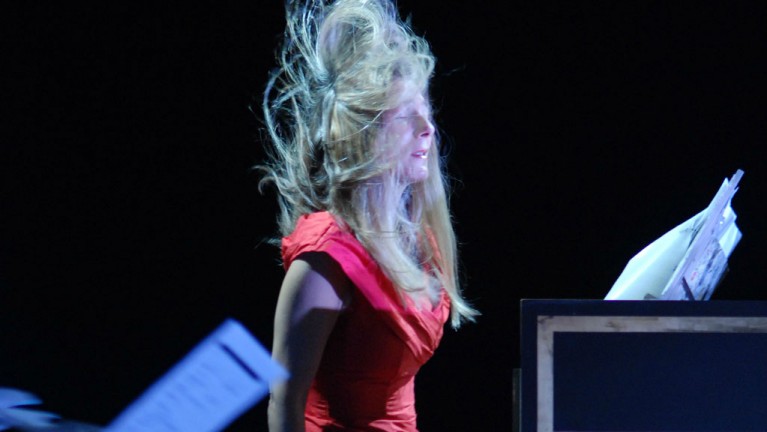
Jane Chapman ft. VJ Gesuidoh
11 May 2013 19:30
Harpsichord with live electronics and visuals
- Kaija Saariaho Jardin Secret II (fixed media electronics)
- Ligeti Continuum
- Kasia Glowicka Thimble Trance (fixed media electronics)
- Tom Armstrong and Jeevan Rai Moto (fixed media electronics) (WP)
- Yumi Hara Cawkwell Molecular dance II
- Flanagan/Chapman Illusive Angels (fixed media electronics) (WP)
- Ikuyo Kobayashi Drops in a flow
- Leo Birtwhistle Subfossil A (live electronics) (WP)
- Des Clarke Linear A (live electronics) (WP)
- Chris Litherland Fortspinnung (WP)
- Ben Eyes Transport (live and fixed media electronics) (WP)
Collaborating with Tokyo-based visual artists VJ Gesuidoh
Images by Norman McBeath
Video by Yoshitaka Adachi/Yumi Hara Cawkwell
Vibe music by Renovatio
Jane Chapman has been described as “Britain’s most progressive harpsichordist” (The Independent on Sunday), and “a fearless contemporary music performer” (The Guardian).
Equally passionate about baroque and contemporary music, she has inspired a new generation of young and established composers, premiering over 200 solo, chamber and electroacoustic works. She is involved in cutting-edge collaborations with visual artists and ground-breaking musicians, bringing the harpsichord to a wide audience through her innovative performances. “Her progressive spirit and comprehensive technique have inspired composers to forge new parameters and sound worlds for the harpsichord with works of unprecedented musical and technological scope” (Harpsichord & Fortepiano). In the words of the Wall Street Journal: “Jane Chapman is one of Britain’s most distinguished classical harpsichordists, with a repertoire that stretches from early music to contemporary avant-garde. Her work is rapidly bringing the harpsichord into the 21st century and establishing her reputation as a rule-breaker.”
Described as “Stylish and eloquent” by The Times, her recordings and recitals reveal both a scholarly and inventive approach to the baroque repertoire. Her CDs of 18th-century English music, ‘The Lady’s Banquet’, and of the 17th-century French ‘Bauyn Manuscript’, offered the first extensive overviews of important sources previously unexplored on disc, and were both highly acclaimed – “One can count on technique to burn and faithful observance of stylistic conventions” (The Musical Times). Recent recordings include works with electronics WIRED (NMC) and Three Windows (DEM), with Mark Wingfield (electric guitar) and Iain Ballamy (sax), also Berio’s ‘Rounds’ (Mode) New York Times pick of the year. She has recently recorded the ‘Oriental Miscellany’, the first transcription of Indian Music into Western notation, published in 1789, and has compiled and edited two issues of ‘Contemporary Music Review’ on the performance of new music. Jane is professor of harpsichord at the Royal College of Music.


VJ Gesuidoh (“VJ Sewer2”) is a visual creation group based in Tokyo. Yoshitaka Adachi and his brother Kazutoshi embarked on VJing in 1999. The team (now 6 members) performs at major club events across Japan and also in Europe.Their VJ materials include raw images of traditional and spiritual Japan and enhanced computer-generated images. Their live performances pay particular attention to the integration of music and the realtime visual (using the CG camera and other high tech equipment). The visual response to the sound is executed immediately, exposing and playing with the complex relationship between music and image. The performance as a whole aims at creating an organically integrated audiovisual experience which has much in common with Zen philosophy. VJ Gesuldoh has also performed with Jane Chapman at the Cargo Club, London.
Leo Birtwhistle is a third year undergraduate at the University of York. His compositions have been performed in Sheffield, York, Singapore, and Huddersfield by a number of professional and amateur ensembles and soloists.
Desmond Clarke is a composer based in the north of England. He has studied composition extensively at the University of York, having completed Bachelors and Masters degrees and is currently studying for a PhD. His music has been performed extensively in and around York, as well as at the University of Manchester, the Royal Northern College of Music and the Alte Aule, Heidelberg. He has worked with numerous student and professional ensembles, including the Diotima Quartet, the Kreutzer Quartet, Jane Chapman, Juice, Vaganza, Cat*er*waul and various improvisatory collectives. His on-going compositional interests and research aims include the reconciliation of process music with an expressive language derived from the 20th century avante-garde, and the role of electronics as a mediator between the physical, intuitive and unintentional aspects of performance.
Linear A, for harpsichord and fixed media, can be seen as a companion piece to Quiet Fundament, for flute, harpsichord, violin and cello. Both take inspiration from the baroque keyboard repertoire and the idea of decay as a process of generation. In Quiet Fundament, material is subtracted from a Bach Allemande, as if eroded by time, to leave a vague, whispered outline. In Linear A, an imaginary harpsichord piece forms a growth medium for additive material, encrusting a tonal framework with winding and invasive melodic lines until little, if any, of the harmonic scaffold remains perceptible – like the invisible foundation of a ruined building shaping the distribution of foliage, or crystals growing inside the voids left by volcanic bubbles.
Chris Litherland studied composition at the RSAMD, Glasgow and Trinity College of Music in London. He is currently studying for an MA in Composition at York.
Fortspinnung is a German word which describes a compositional technique frequently employed by composers of the 18th Century. Literally “spinning forth”, it is characterized by a process of continuous development generated from the manipulation of a single motivic fragment. The image appeals to my —highly romantic — notion of the harpsichord as a domestic instrument. “Spinning” here has connotations of weaving: the cyclical, repetitive motion of the loom, the music, like a thread spun out, constant and consistent. But there is also a narrative strand to the imagery: that sense of a tale “spun forth”, a tale, perhaps, told in an intimate, domestic space, to a few who will listen. The process of unraveling also informs this piece: a coming-loose of the musical threads, which run through the work, a gradual disintegration of the musical fabric, and breaking-apart of the musical narratives.
Ben Eyes is a musician and sound engineer working and studying in Leeds and York. Having spent many years tearing up dance floors and festivals across Europe creating experimental electro under the moniker Quip, Ben has recently embarked on a Masters in Music Technology at the University of York. Through new avenues of exploration Ben is creating more thoughtful, contemplative music under his own name. Influenced by early electronic pioneers (some of whom studied in York) as much as today’s cutting edge music production, Ben’s change of direction has already proved fruitful, resulting in a collaboration with fellow student Chris Mullander and a release on The Centrifuge electronica record label. Ben is currently working towards further releases and collaborations with other students and musicians.
Transport I am interested in the relationship between acoustic and electronic sounds and how the two can be woven together in a live context between performers. Inspired by movement of mass transport and my daily commute to work in York I wanted to create a sense of movement and exploration and also blur the line between the electronic sounds of the computer and the unique acoustic sound of the harpsichord. This piece has been formed using my own programmed computer patches for rhythmic generation and the manipulation of the sound of the harpsichord. As Jane plays I grab and twist the sounds she makes, and in turn she responds creating unique sounds not usually associated with the harpsichord. We have worked closely together shaping the piece you hear tonight, a process I thoroughly enjoyed and found hugely informative.
Ticket prices
£12 (£10)
Buy tickets
- Online
Buy online - By email
[email protected] - By telephone
+44 (0)1904 322 439
Venue
Rymer Auditorium
Department of Music, University of York
York
YO10 5DD